Want to convert XML to CSV with specific fields?
Try DataFileConverter, a XML to CSV converter for Windows, MacOS, and Linux, Convert XML to CSV with specific columns, Easy and Fast.
- Can run in GUI mode, Step by Step, just a few mouse clicks.
- Can run in Command line, for Scheduled Tasks and Streams.
- Filter files locally and privately, avoid uploading XML file(s) to online services.
Download Withdata DataFileConverter 
Convert XML to CSV with specific fields
Choose XML file -> Select needed columns for CSV -> Convert XML to CSV with specific fields
“Start a New Convert” for “XML to CSV”.
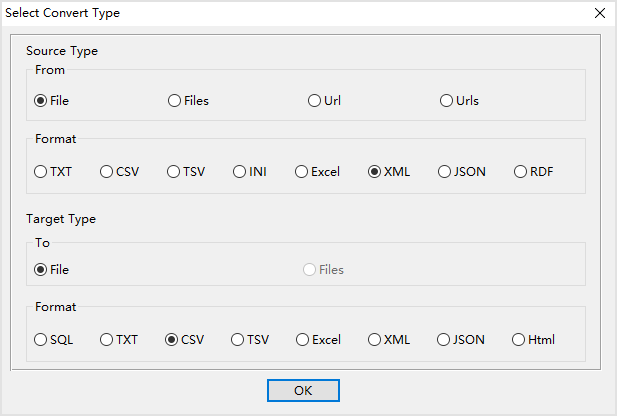
Select From “File” “XML” To “File” “CSV”.
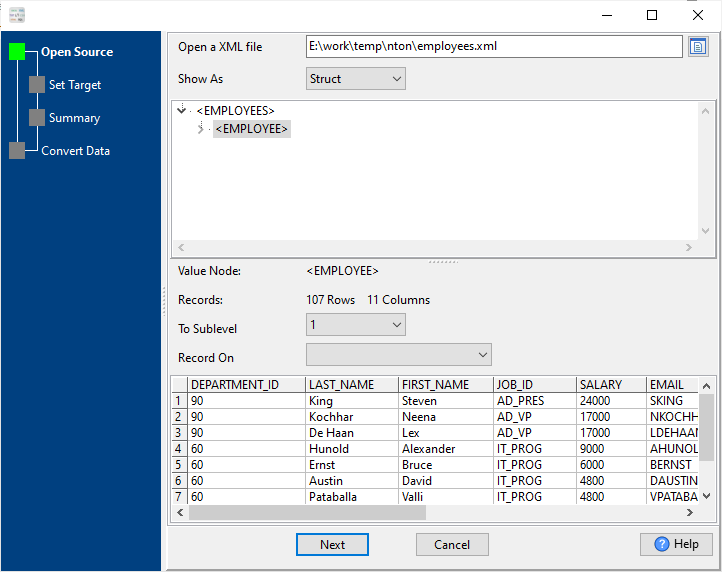
1. Open source XML file.
Support large XML file ( > 4GB ).
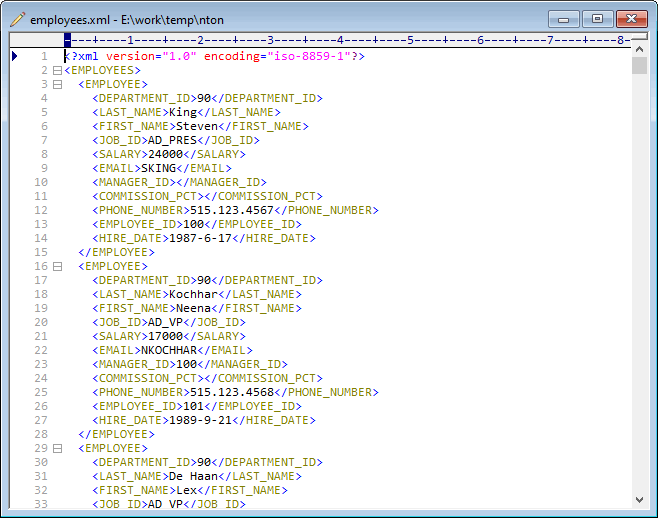
Source XML file’s content is like this:
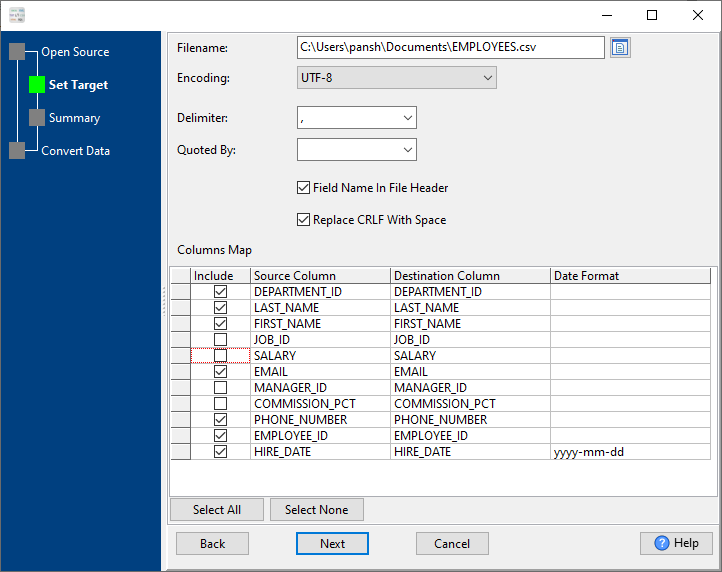
2. Config target CSV file, select only needed columns, or just drop certain columns.
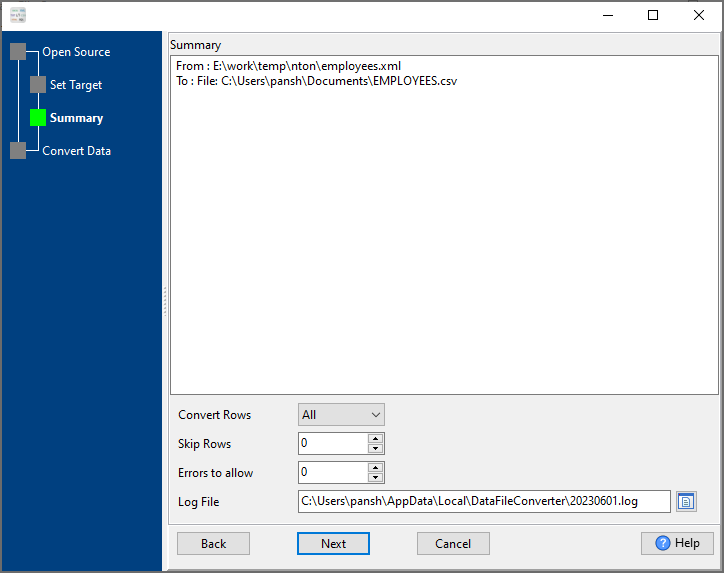
3. Set rows options.
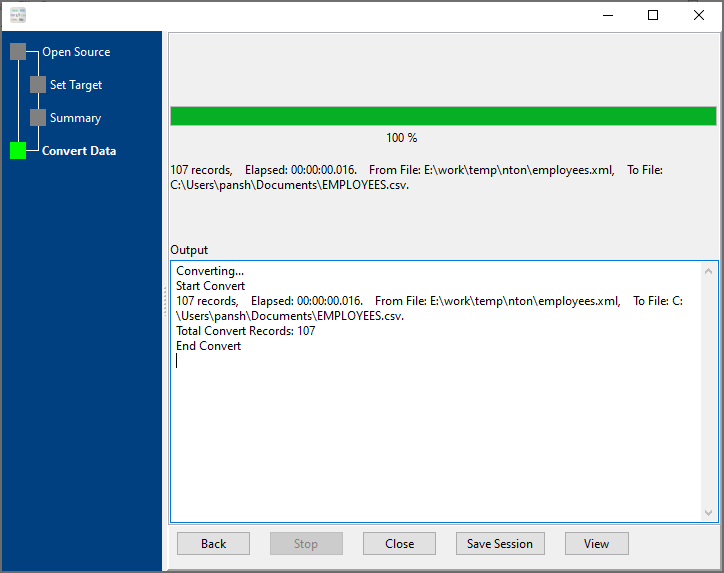
4. Convert XML to CSV with specific fields.
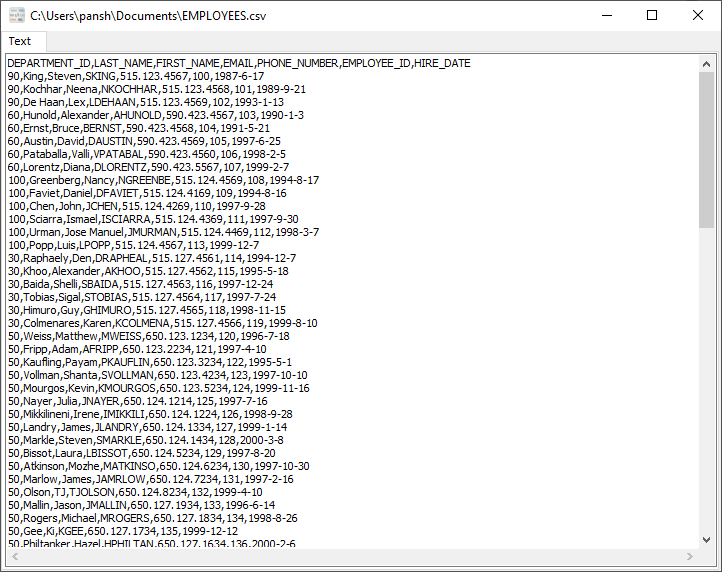
After converting, you can view the output CSV file.
Convert XML to CSV with specific fields in command line
Save “XML to CSV” session, then you can:
- Convert XML to CSV with specific fields in Windows command line.
- Convert XML to CSV with specific fields in Linux command line.
- Convert XML to CSV with specific fields in macOS command line.
Set scheduled tasks for converting XML to CSV with specific fields
You can schedule and automate this “XML to CSV” conversion task by:
- Save session and create .bat (Windows) or .sh (Linux/macOS) file for “XML to CSV” conversion.
- Set scheduled task for “XML to CSV” conversion.
FAQ
More about Withdata DataFileConverter – XML to CSV converter
Download Withdata DataFileConverter
See Video: Convert XML to CSV with specific fields
XML → CSV reference
Type mapping
| Value kind | in XML | in CSV |
|---|---|---|
| Int | <int>1234</int> | 1234 |
| Bigint | <bigint>9007199254740993</bigint> | 9007199254740993 |
| Decimal | <decimal>1234.56</decimal> | 1234.56 |
| Float | <float>1.234e10</float> | 1.234e+10 |
| Text | <char>text</char> | quoted only when it contains a comma or a quote |
| Long text | <text>multi-line text</text> (entities for & <) | must be quoted; line breaks inside force multi-line records |
| Date | <date>2026-09-18</date> (xs:date with an XSD) | 2026-09-18 |
| Datetime | <datetime>2026-09-18T14:30:00Z</datetime> (xs:dateTime) | 2026-09-18 14:30:00 |
| Binary | <blob>base64...</blob> (xs:base64Binary) | not representable - base64 or hex string |
| Boolean | <bool>true</bool> | TRUE / FALSE, or 1 / 0 depending on the writer |
| JSON | escaped inside an element, or its own sub-tree | the whole JSON value quoted, with internal quotes doubled |
Dialect differences
Both XML and CSV are file formats, so what differs below is how each one chooses to represent a value.
| Property | in XML | in CSV |
|---|---|---|
| identifiers | Attribute values in quotes; entities (& < >) for ... | Double quotes; a literal quote is doubled ("" ) |
| dates | Text (xs:date / xs:dateTime when an XSD is in play) | Conventional text: 2026-09-18 or 2026-09-18 14:30:00 |
| binary | base64Binary / hexBinary inside text | Not supported |
| separator | Tags, not delimiters | Comma "," |
| encoding | Declared in the XML declaration | No declaration - UTF-8 works only with a BOM |
| typing | None in the markup itself | None - every field is text |
| shape | Arbitrary tree | Flat table, optional header row |
| ceiling | Whole document is usually parsed into memory | No formal limit; row count bounded by memory |
Data File Converter without the manual work
For batch jobs, large files and scheduling use the Data File Converter converter — an offline desktop app for Windows, Linux and macOS. Free trial.