Want to parse online RSS feeds and save to MongoDB collection? Want to schedule and automate this importing task?
Try Withdata FileToMongo, a RSS to MongoDB converter for Windows, MacOS, and Linux, Import RSS feeds to MongoDB, Easy and Fast.
- Can run in GUI mode, Step by Step, just a few mouse clicks.
- Can run in Command line, for Scheduled Tasks and Streams.
- Support all MongoDB deployment types: standalone, replica set, sharded cluster, and MongoDB Atlas.

Import online RSS feeds to MongoDB collection
Click “1 File To 1 Collection” at task dialog.
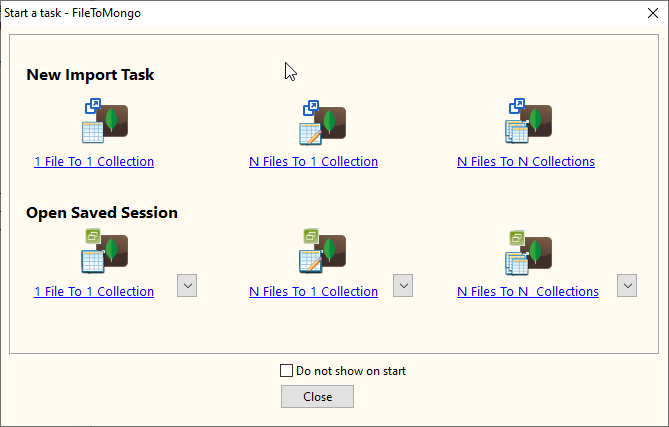
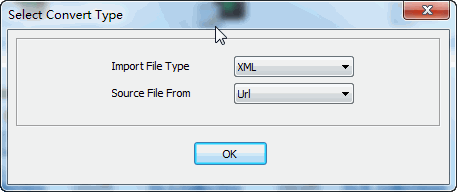
Select “Import File Type” with “XML”, and select “Source File From” with “Url”.
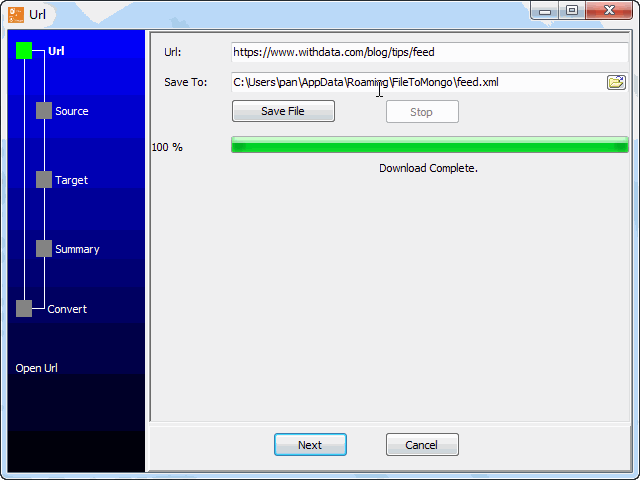
1. Input the RSS feeds URL, and download to XML file.
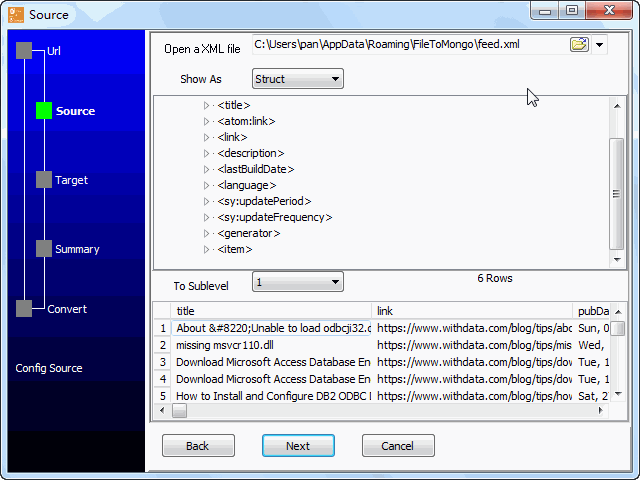
2. Open the saved XML file.
3. Config target MongoDB collection.
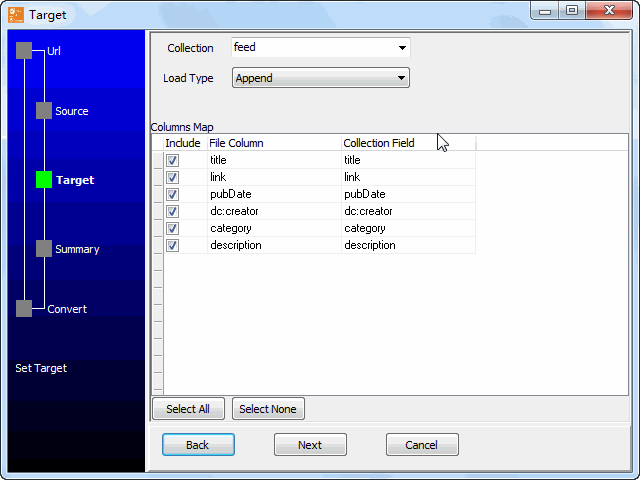
4. Preview data will be in MongoDB collection.
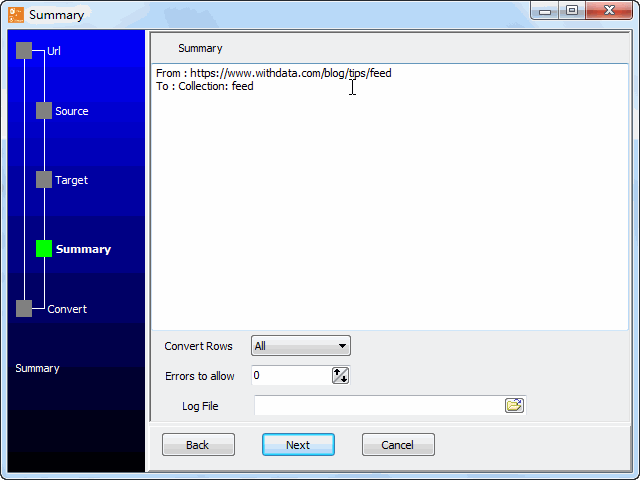
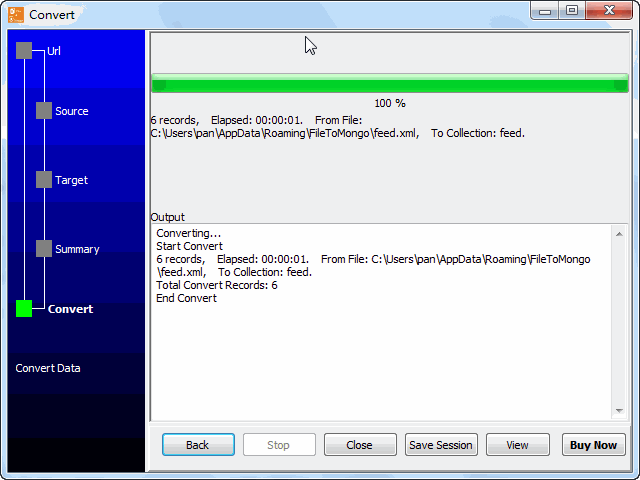
5. Import RSS to MongoDB.
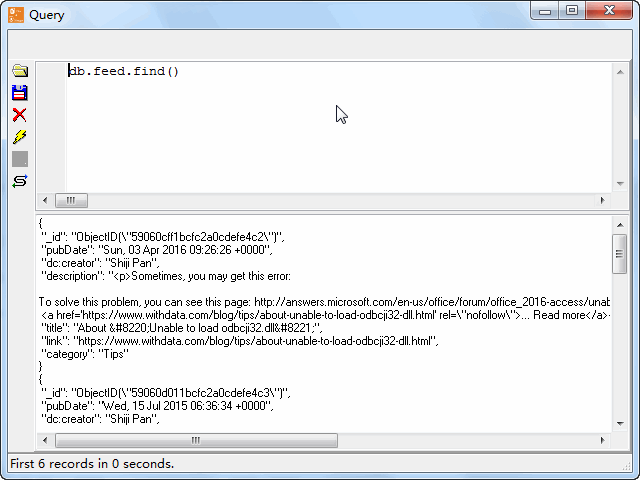
See importing results in MongoDB collection
Import RSS to MongoDB in command line
Save “RSS to MongoDB” session, then you can:
- Convert RSS to MongoDB in Windows command line.
- Convert RSS to MongoDB in Linux command line.
- Convert RSS to MongoDB in macOS command line.
Set scheduled tasks for importing RSS to MongoDB
You can schedule and automate this “RSS to MongoDB” conversion task by:
- Save session and create .bat (Windows) or .sh (Linux/macOS) file for “RSS to MongoDB” conversion.
- Set scheduled task for “RSS to MongoDB” conversion.
FAQ
More about Withdata FileToMongo – RSS to MongoDB Converter
Download Withdata FileToMongo
RSS → MongoDB reference
Type mapping
| Value kind | in RSS | in MongoDB |
|---|---|---|
| Int | <int>1234</int> or a child element | NumberInt / int32 |
| Bigint | <bigint>9007199254740993</bigint> | NumberLong / int64 |
| Decimal | <decimal>1234.56</decimal> | Decimal128 |
| Float | <float>1.234e10</float> | Double |
| Text | <title>text</title> | String |
| Long text | <description>text</description>, usually wrapped in CDATA | String |
| Date | <pubDate>Mon, 18 Sep 2026 00:00:00 GMT</pubDate> (RFC 822) | ISODate |
| Datetime | <pubDate>Mon, 18 Sep 2026 14:30:00 GMT</pubDate> (RFC 822) | ISODate |
| Binary | an enclosure URL, never inline bytes | BinData |
| Boolean | not part of the feed vocabulary | Bool |
| JSON | not part of the feed vocabulary | Embedded document or array |
Dialect differences
RSS is a file format and MongoDB is a database server, so the target has to be told the types the file never carried – the rows below are where the two sides diverge.
| Property | in RSS | in MongoDB |
|---|---|---|
| port | — | 27017 |
| identifiers | XML quoting; content is usually escaped in CDATA | No identifier quoting - names are plain strings |
| row limit | — | .limit(n) / $limit aggregation stage |
| dates | RFC 822 text, for example Mon, 18 Sep 2026 14:30:00 GMT | ISODate() / BSON date (millisecond epoch internally) |
| long text | — | String (BSON string, no length limit) |
| binary | Via enclosure URLs, not inline | BinData (BSON binary subtype) |
| separator | XML elements | — |
| encoding | Declared in the XML declaration | — |
| typing | None | — |
| shape | Channel plus repeated <item> elements | Collections of documents with optional nesting |
| ceiling | A feed is a window on recent items, not a full data set | — |
Command line
| Side | Command |
|---|---|
| MongoDB | mongoexport --collection=c --out=f.json |
| MongoDB (load) | mongoimport --collection=c --file=f.json |
FileToMongo without the manual work
For batch jobs, large files and scheduling use the FileToMongo converter — an offline desktop app for Windows, Linux and macOS. Free trial.