FileToMongo batch imports 10+ file formats to MongoDB with speed and security. Process millions of rows locally, support cross-platform, CLI, and scheduled tasks for enterprise-level efficiency.
INI to MongoDB
Import multiple files or entire folders to MongoDB collections in one click. Support recursive folder scanning and automatic collection mapping.
Optimized algorithm processes millions of rows in minutes. Handle GB-level files without memory limits, even for 100GB+ datasets.
All data processing happens locallyโno file uploads to cloud. Protect sensitive enterprise data with 100% privacy guarantee.
Works seamlessly on Windows (32/64bit), Mac OS, and Linux (Debian/Ubuntu/Red Hat). Consistent experience across all operating systems.
Automate imports with CLI support. Integrate with scripts and batch processes for hands-free data migration workflows.
Set up daily/weekly scheduled imports. Automate routine data migration tasks without manual intervention.
Save import configurations as sessions. Load and reuse them for repetitive tasks to save time on setup.
Automatically detect file encoding (UTF-8, GBK, ISO-8859-1 etc.). Avoid garbled data during import.
Choose single files, multiple files, or entire folders. Support drag & drop for quick selection.
Map files to MongoDB collections, set encoding, and adjust advanced options as needed.
Click "Import" and monitor progress in real-time. Get completed files in minutes.
Loading a spreadsheet or a CSV export into MongoDB usually means a shell and a command-line utility. FileToMongo does the same job with a screen in front: point it at the file, point it at the collection, check the field mapping, and import.
Import a CSV, TSV, TXT, Excel, JSON, JSONL, XML, HTML, RDF or SQL file into a new or an existing collection, and let the field mapping be detected from the header row. Encoding is detected as well, so a file exported from Excel on Windows does not arrive full of garbled text. See CSV to MongoDB and Excel to MongoDB.
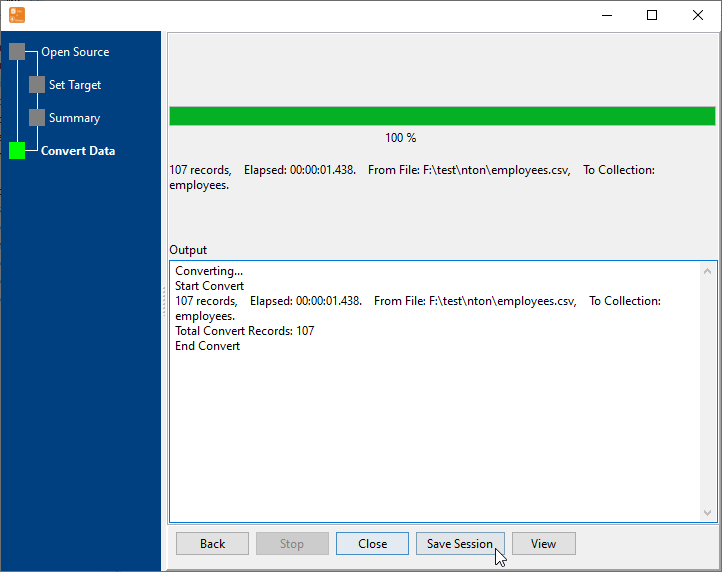
A single file into a single collection, one file into several collections, or every file in a folder into its own collection - the whole folder can be loaded in one run. Millions of rows are streamed, so the import does not depend on how much RAM the machine has.
The official mongoimport utility is the right tool if you live in a shell and only need JSON or CSV. FileToMongo is for the rest: a GUI when you want one, Excel, XML, HTML, RDF and SQL as well as CSV and JSON, a field mapping you can check before the import runs, update and upsert instead of insert-only, a whole folder at a time, a command line for scripting, and scheduled tasks. Either way the data never leaves your machine.
Need the other direction? MongoToFile exports collections to files, MongoLoader does both, and DBToMongo copies a relational database into MongoDB. Every MongoDB task is listed on the MongoDB tools page.
FileToMongo processes millions of rows in minutes. The exact speed depends on your hardware, file size, and MongoDB server performance. A 1GB CSV file with 10 million rows typically takes 5-10 minutes to import.
Yes. All data processing happens locally on your computerโno files or data are uploaded to external servers or the cloud. This ensures maximum security for sensitive enterprise data.
Yes. FileToMongo works with both local MongoDB instances and MongoDB Atlas (cloud). Simply enter the connection string for your Atlas cluster during setup, and the import will work seamlessly.
Absolutely. FileToMongo includes a task scheduler that lets you set up daily, weekly, or custom-scheduled imports. You can save your import configuration as a session and schedule it to run automatically.
FileToMongo supports MongoDB 3.0 and above, including the latest versions (7.x and 8.x). It's compatible with all major MongoDB editions (Community, Enterprise, Atlas).
Yes. All purchases include free technical support via email.
Point FileToMongo at the CSV file and the target collection, check the detected field mapping, and choose insert, update or upsert. Existing collections can be updated in place instead of being loaded twice.
Yes. One file can go into one collection, several files into one collection, or every file in a folder into its own collection - the whole folder is processed in a single run.
mongoimport is the official MongoDB command-line utility - ideal in a shell, limited to JSON and CSV. FileToMongo adds a GUI, Excel, XML, HTML and RDF input, a field mapping you can review first, update and upsert, folder-level batch import, a command line and scheduled tasks.
"FileToMongo has transformed our data migration workflow. We used to spend hours importing CSV files to MongoDB manuallyโnow it takes minutes. The CLI support let us automate the entire process."
"As a DevOps engineer, I need tools that integrate with our existing scripts. FileToMongo's CLI and session features make it perfect for our automated data pipeline. It's reliable and fast."
"We process large datasets daily, and FileToMongo handles our 50GB+ CSV files without breaking a sweat. The local processing gives us peace of mind about data security, which is crucial for our business."
Ready to Import File to MongoDB Effortlessly?
Download FileToMongo Free Trial