Want to import data from Excel file to SQL Server ?
Try Withdata FileToDB, a desktop Excel to SQL Server converter for Windows, MacOS, and Linux, Convert Excel to SQL Server, Easy and Fast.
- Can run in GUI mode, Step by Step, just a few mouse clicks.
- Can run in Command line, for Scheduled Tasks and Streams.
- Import Excel to SQL Server locally and privately, avoid uploading Excel file(s) to online services.
- Support Windows, Linux, and macOS.

SQL Server is the strictest of the three about what a spreadsheet may hand it. The import
wizard is four steps; everything that goes wrong happens in the mapping and in the first bad row:
| What goes wrong | Why | Fix |
|---|---|---|
| The imported ids are not the ids you sent | The column is an IDENTITY: SQL Server generates its own sequence and ignores the values |
Import into a plain int column, or SET IDENTITY_INSERT … ON for the load |
Chinese text arrives as ? |
The column is varchar (single-byte code page) rather than nvarchar |
Use nvarchar/nvarchar(max) for anything that is not plain ASCII |
Dates lose their seconds / come back as 1900-01-01 |
datetime rounds to 3 ms and starts in 1753; a bad conversion falls back to the default |
datetime2 for new tables; check the mapping for the date column before running |
Bulk load data conversion error (truncation) for the whole file |
BULK INSERT/bcp reject the batch on the first conversion error unless MAXERRORS is raised |
Stage into nvarchar(max) columns, then CAST into the real table |
Import data from Excel to SQL Server in 4 steps
Choose Excel file -> Set SQL Server table -> Preview SQL Server table -> Import Excel to SQL Server
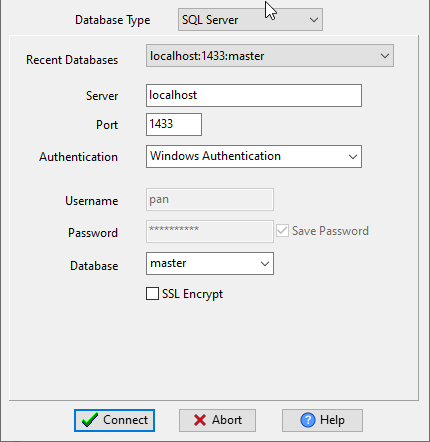
Choose SQL Server and logon.
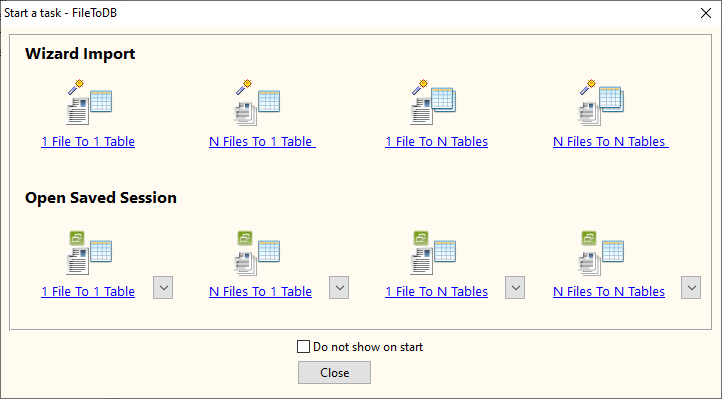
Click “Wizard – 1 File To 1 Table” for “Excel to SQL Server”.
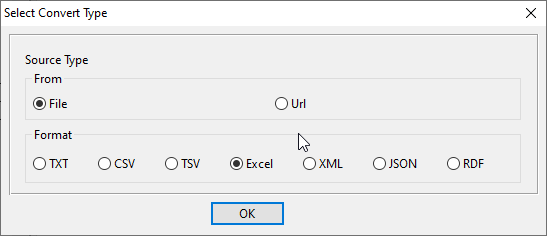
Select the “Excel” file type.
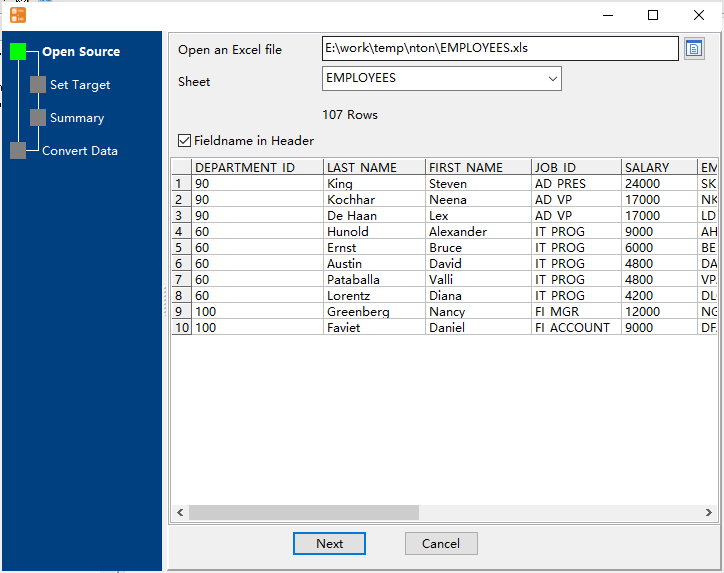
then show the wizard.
Step #1. Open an Excel file.
Step #2. Select a SQL Server table and config fields.
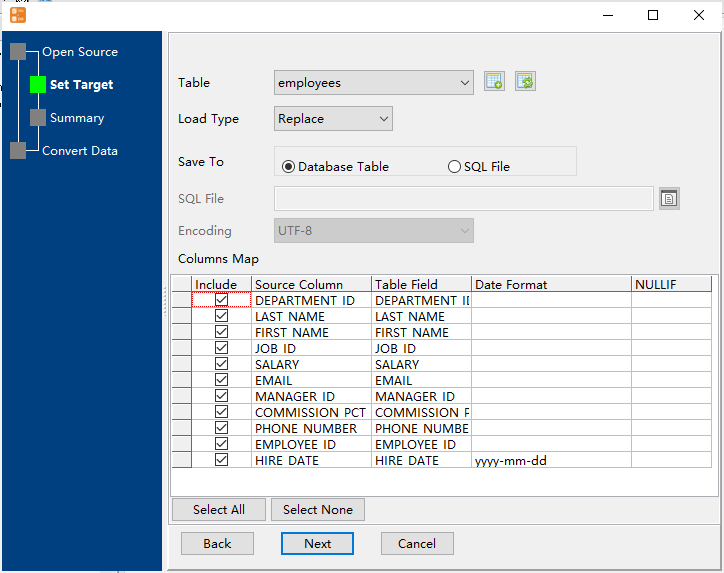
Step #3. Preview SQL Server table.
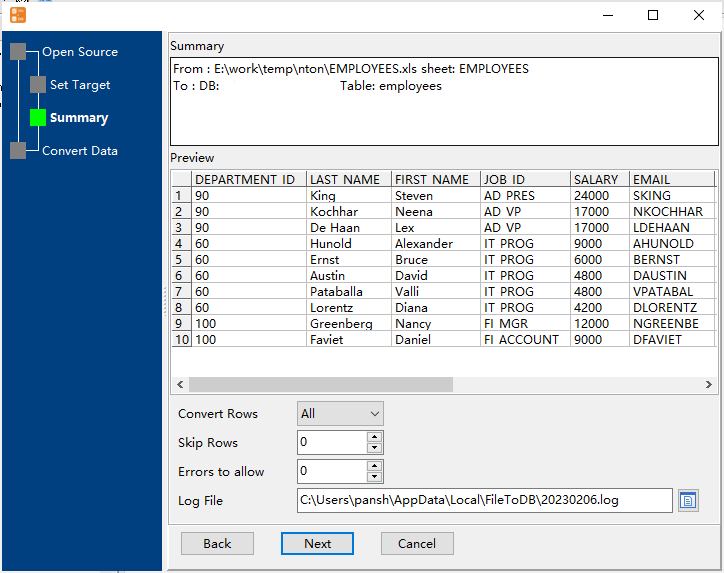
Step #4. Import Excel to SQL Server.

More about Excel to SQL Server converter
Download Withdata FileToDB
Excel type to SQL Server type
Two decisions matter more than the rest: nvarchar instead of varchar, and
datetime2 instead of datetime. The rest is sizing.
| In the sheet | In SQL Server | Watch out for |
|---|---|---|
| Text with accents or CJK | nvarchar(n), nvarchar(max) |
varchar stores one byte per character in a code page; anything outside it is lost as ? |
| Date and time | datetime2(0) or date |
datetime rounds to .000/.003/.007 and cannot hold dates before 1753. |
| Money | decimal(12,2) |
Not float; and money is a legacy type with its own quirks. |
| Numbers from the sheet | int, bigint |
A cell formatted as text may arrive as '1,234' and fail the cast. |
| True/false column | bit |
Accepts 1/0; the strings need converting first. |
Identifiers: brackets and case-insensitive collation
SQL Server quotes identifiers with [square brackets], and by default the collation is
case-insensitive, so OrderDate and orderdate are the same column — which
is convenient until two sheets produce headers that differ only in case and get merged into one column.
Column names with spaces need the brackets everywhere, and a header that is a keyword
(order, key, percent) does too; renaming during the mapping step is
still cheaper.
Finding the rows that fail
Bulk loading in SQL Server is fast and unforgiving: BULK INSERT and bcp stop at
the first conversion error unless MAXERRORS is set, and a failed batch inside a transaction rolls
back as a unit. Raising MAXERRORS buys you a partial load — which is useful only if you can
tell which rows arrived.
- Stage into
nvarchar(max)and convert with explicitCAST/TRY_CAST:
TRY_CASTreturnsNULLinstead of failing, so a query can list the rows it could not read. - Keep the sheet row number as a column in staging; it is the only handle back to the spreadsheet.
- Load in batches so one bad row costs a batch, and check
@@ROWCOUNTagainst the number of
rows you sent — the cheapest possible reconciliation.
Many sheets, many files, every night
Append every sheet to the same table, or create one table per sheet when the sheets are different entities;
a folder of workbooks runs as a single job. The in-tool session can be saved and scheduled, which is what turns
“the monthly import” into a task rather than a ritual.
Other directions: SQL Server to Excel,
and the same guide for the other two databases —
PostgreSQL
and MySQL.