Want to import data from TXT (“;” semicolon delimited text) file to xBase?
Try Withdata FileToDB, a desktop TXT to xBase converter for Windows, MacOS, and Linux, Convert TXT to xBase, Easy and Fast.
- Can run in GUI mode, Step by Step, just a few mouse clicks.
- Can run in Command line, for Scheduled Tasks and Streams.
- Convert locally and privately, avoid uploading large or private TXT file(s) to online services.
- Support Windows, Linux, and macOS.

Import data from TXT (“;” semicolon delimited text) file to xBase
Login to xBase -> Choose TXT file -> Set xBase table -> Import TXT to xBase
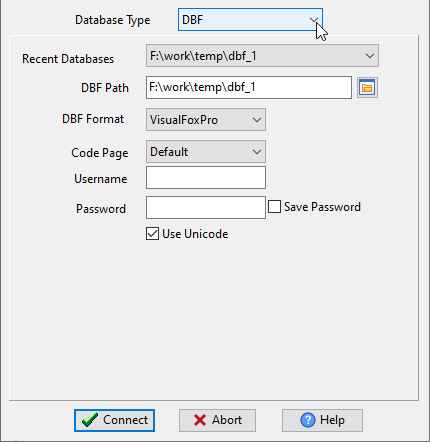
Choose xBase and logon.
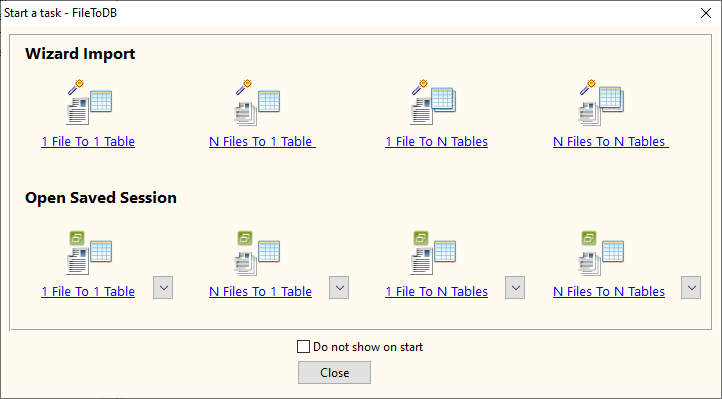
Click “Wizard – 1 File To 1 Table” at task dialog.
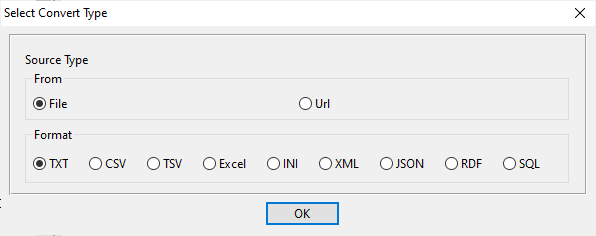
Select the “TXT” file type.
then show the wizard.
1. Open a TXT (“;” semicolon delimited text) file.
Support large ( > 4GB ) TXT file.
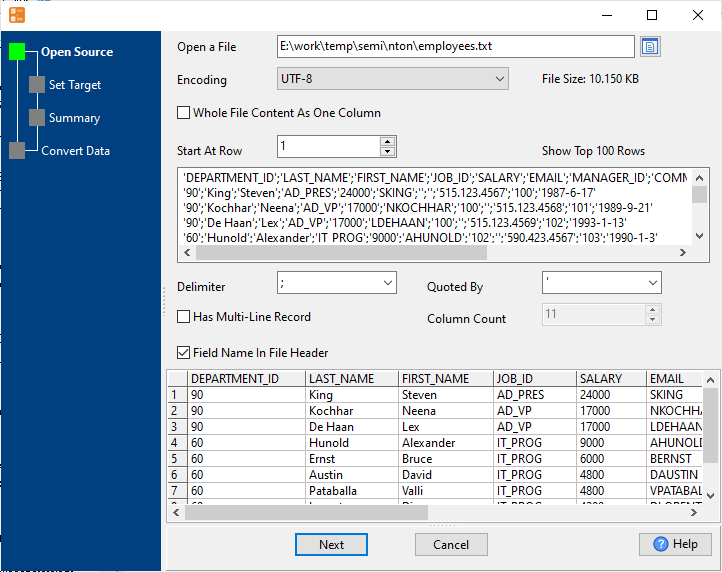
Here is the file’s content.
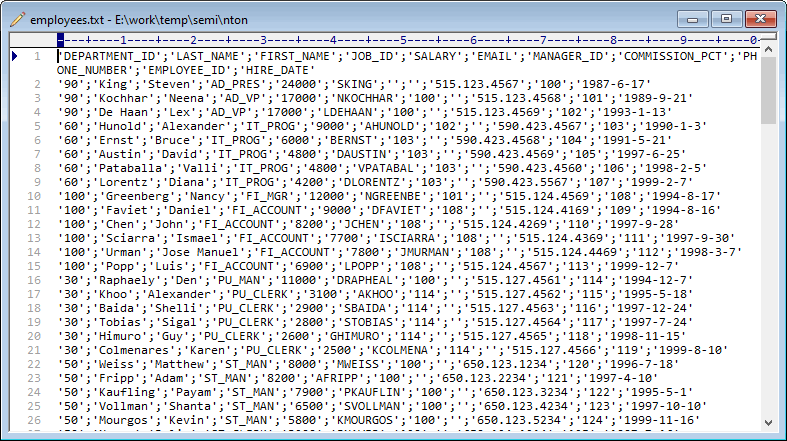
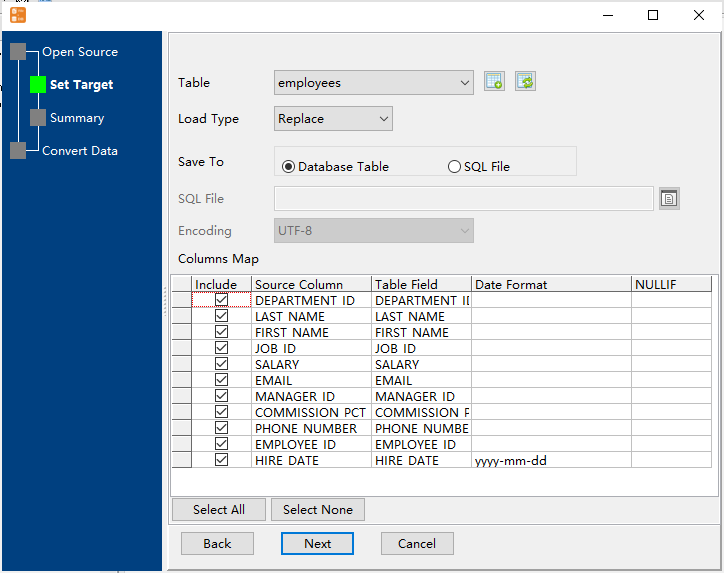
2. Select a xBase table and config fields.
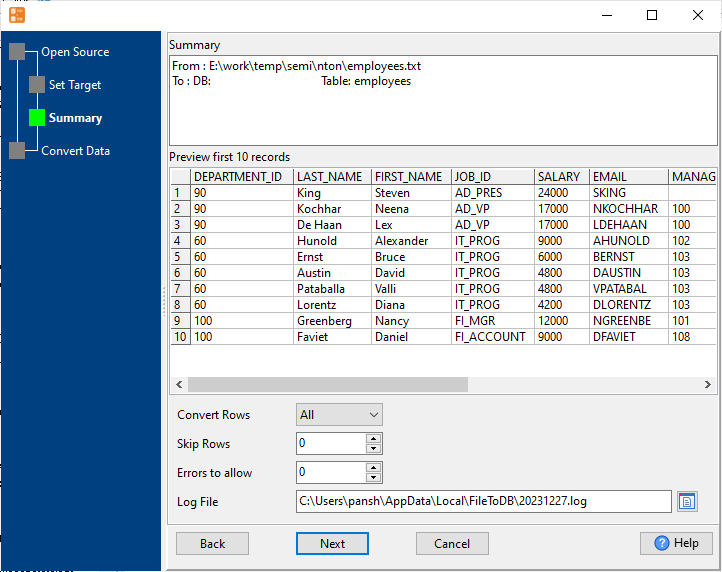
3. Preview data will be in xBase table.
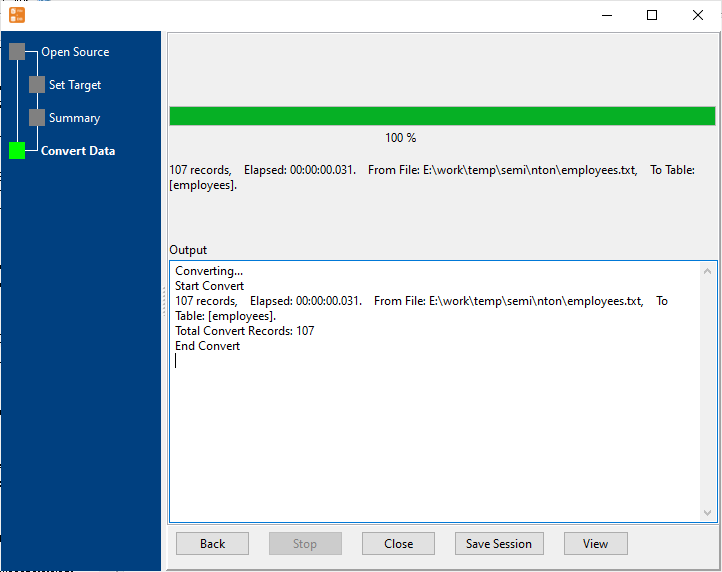
4. Import TXT data to xBase.
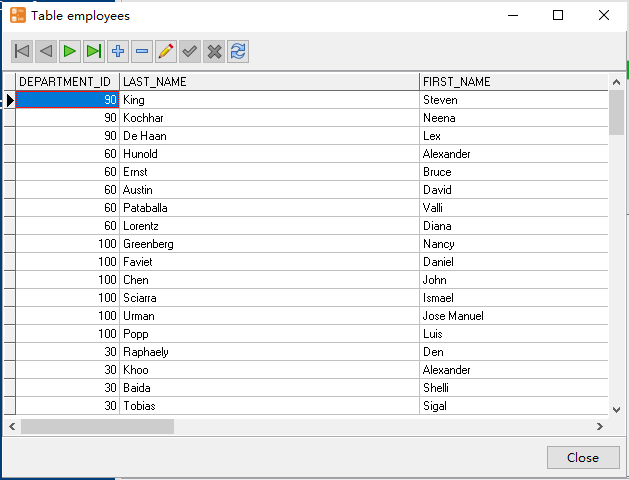
View imported data in xBase table
Import TXT to xBase in command line
Save “TXT to xBase” session, then you can:
- Import TXT to xBase in Windows command line.
- Import TXT to xBase in Linux command line.
- Import TXT to xBase in macOS command line.
Set scheduled tasks for importing TXT to xBase
You can schedule and automate this “TXT to xBase” conversion task by:
- Save session and create .bat (Windows) or .sh (Linux/macOS) file for “TXT to xBase” conversion.
- Set scheduled task for “TXT to xBase” conversion.
FAQ
What is Withdata FileToDB?
How long does it take to import TXT (“;” semicolon delimited text) data to xBase?
Is it safe to import TXT (“;” semicolon delimited text) data to xBase using FileToDB?
Can I import TXT (“;” semicolon delimited text) data to xBase on Linux, Mac OS?
Can I import TXT (“;” semicolon delimited text) data to xBase in command line?
More about Withdata FileToDB – TXT (“;” semicolon delimited text) to xBase converter
Download Withdata FileToDB
See also:
Semicolon-delimited text → xBase reference
Type mapping
| Value kind | in Semicolon-delimited text | in xBase |
|---|---|---|
| Int | 1234 | Numeric(10,0) |
| Bigint | 9007199254740993 | Numeric(19,0) |
| Decimal | 1234.56 | Numeric(p,s) |
| Float | 1.234e+10 | Float |
| Text | quoted only when it contains a semicolon or a quote | Character(n) |
| Long text | must be quoted; line breaks inside force multi-line records | Memo |
| Date | 2026-09-18 | Date |
| Datetime | 2026-09-18 14:30:00 | (none) |
| Binary | not representable - base64 or hex string | (none) |
| Boolean | TRUE / FALSE, or 1 / 0 depending on the writer | Logical |
| JSON | the whole JSON value quoted, with internal quotes doubled | (none) |
Dialect differences
Semicolon-delimited text is a file format and xBase is a database server, so the target has to be told the types the file never carried - the rows below are where the two sides diverge.
| Property | in Semicolon-delimited text | in xBase |
|---|---|---|
| port | — | (file-based) |
| identifiers | Double quotes; a literal quote is doubled ("" ) | — |
| row limit | — | (driver dependent) |
| dates | Dates often use D/M/Y or D.M.Y in European exports | Date (D) |
| long text | — | Memo (M) |
| binary | Not supported | — |
| separator | Semicolon ";" | — |
| encoding | Often ANSI or Latin-1 in European exports; UTF-8 needs a BOM | — |
| typing | None - every field is text | — |
| shape | Flat table, optional header row | Tables of rows and columns |
| ceiling | No formal limit; row count bounded by memory | — |
No counterpart
- Semicolon-delimited text values of kind Date and time have nowhere to go in xBase.
- Semicolon-delimited text values of kind Binary have nowhere to go in xBase.
- Semicolon-delimited text values of kind JSON have nowhere to go in xBase.
Convert your data online, free
Free in-browser converters for CSV, Excel, JSON, XML and SQL: Withdata Online Data Conversion. Large files, batch conversion or scheduling? See the offline desktop apps, or browse all data conversion tools.