Sooner or later somebody asks for the invoice you booked in March: the accountant, the auditor, the tax office, or the supplier who says it was never paid. The spreadsheet row is not the answer - the document is.
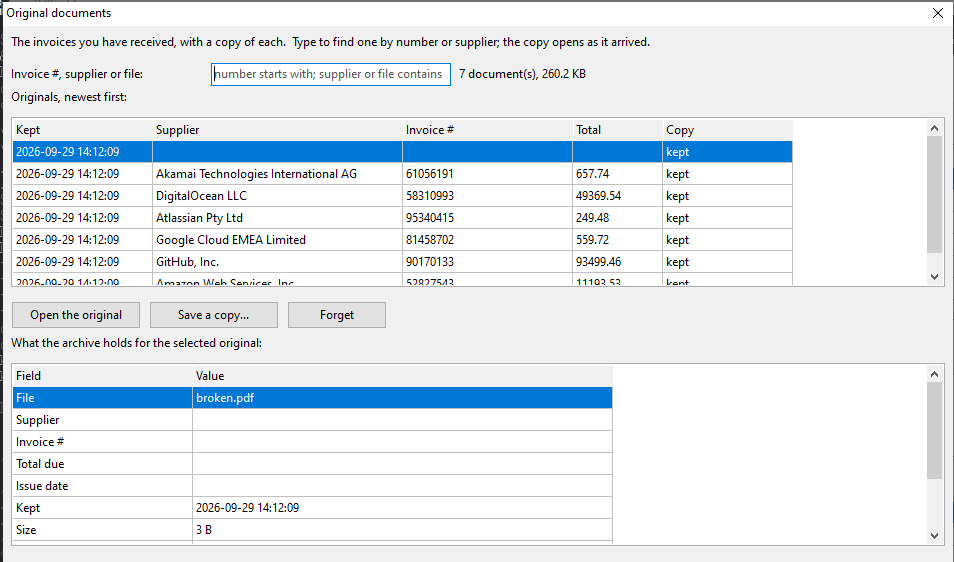
Every invoice taken in is copied into a local archive, without being asked, before anything is read from it - including the ones that could not be read at all.
Tools → Original documents... searches by invoice number, by supplier, or by the file name it came in as.
The original opens as the PDF it always was. A document you no longer want to keep can be forgotten - and the archive tells you what is there and how much room it takes.
Each original is identified by its own SHA-256 hash. Two copies of the same file are one document in the archive, however they were named - and a file that has been edited is a different document, not the same one.
You rarely remember the file name. Search by the invoice number off the paperwork, by the supplier, or by part of the name - the archive matches all three against what was read at the time.
It is a directory on your own disk, not a service. You can back it up with everything else, move it, or decide you do not want it and turn the keeping off.
A file that could not be read is still what the supplier sent. The archive keeps it, because "we received this and could not read it" is a thing you may need to prove.
Turning a month of invoices into one spreadsheet · Checking whether an invoice has already been paid · Keeping the invoices off somebody else's server
Everything happens on this computer - your invoices are never uploaded.