MongoLoader » Use cases » One tool for both directions
Download MongoLoader Free Trial » Buy MongoLoader Now »
The situation
Most teams do not only import or only export. The same database feeds a report as a spreadsheet every Monday, and receives files from the same report when somebody corrects the numbers. Supporting that with separate tools means two licences, two upgrade cycles, two sets of settings, and a mapping that is maintained twice.
What it does in each direction
- Out: a collection, or a query result, to CSV, TSV, Excel, JSON, XML, HTML or SQL - with nested documents flattened into columns, a field selection, and the cleaning rules of an export. Many collections at once go to many files.
- In: a CSV, TSV, Excel, JSON, XML, TXT, HTML or SQL file into a new or an existing collection, with automatic field mapping and a choice of insert, update or upsert. A whole folder of files can be loaded in one run, with collections named from the file names.
- The same across both: saved sessions so a job repeats in one click, a command line so it can run unattended, and a task scheduler behind that for nightly work.
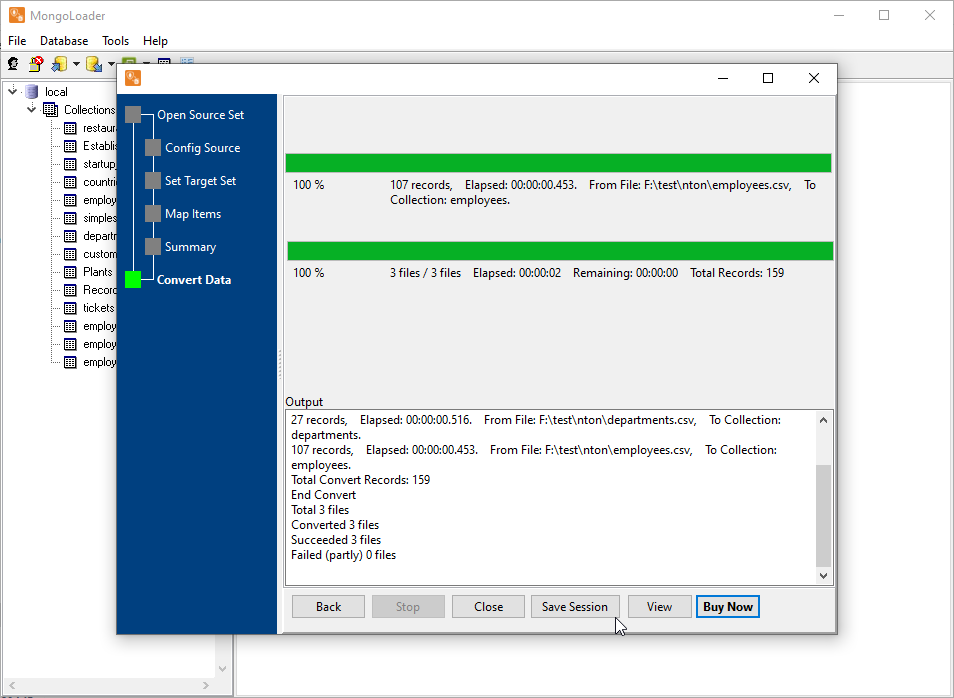
Everything runs locally against the servers you name - no cloud service in the middle, no staging copy of the data. If a team only ever needs one direction, the dedicated tools are MongoToFile (out) and FileToMongo (in); this is for the teams that need both.
What it will not do
- It does not synchronise. Each direction is a task that runs when it is run. There is no change tracking, no oplog reading and no continuous replication between MongoDB and the files.
- It does not move data between two MongoDB servers. The pair here is MongoDB plus files. Server-to-server is DBToMongo, and relational-to-relational is DBCopier.
- It does not manage the data model. Fields are mapped to documents and back; collections, indexes and validators are yours.
- It is not a backup. The files are readable exports, not restorable database images.
Related
The round trip in practice: export, edit, import back. Cleaning: clean the data on the way out. Scale: 100GB+ files. The modes: collection to file, file to collection, folder to collection, collections to files.